

Moving a hot tub safely requires more than lifting. You must disconnect and drain the spa, verify its dry weight and permitted transport position, measure and clear the route, and use load-rated equipment with enough capable help.
A short move over flat, accessible ground may be suitable for a carefully planned DIY team. Use professional hot tub movers when the route involves stairs, steep slopes, elevated decks, tight access, long-distance transport, or a crane. Never try to move a conventional hard-shell hot tub alone.
This guide covers portable, above-ground hard-shell hot tubs. In-ground or built-in spas and swim spas require specialist assessment and equipment.
Quick Answer: What Is the Safest Way to Move a Hot Tub?
The safest way to move a hot tub is to plan the route, use equipment rated for the verified load and compatible with the spa manufacturer’s instructions, and keep the load controlled from start to finish:
- Check the owner manual, warranty, dimensions, dry weight, and permitted transport orientation.
- Measure the route, prepare the destination, and gather rated equipment and capable helpers.
- Turn off and safely disconnect the power.
- Drain the shell and remove as much accessible residual water as practical.
- Remove detachable accessories and protect the spa with padding.
- Move it slowly, load it into a suitable vehicle, and secure it for transport.
- Unload, inspect, reconnect, refill, reinstall accessories, and test the spa.
Manufacturer instructions for your model take priority over general online guidance. If the manual does not explain a lifting point or transport position, stop and ask the manufacturer, dealer, or an experienced mover.
Should You Move a Hot Tub Yourself or Hire Professionals?
The right choice depends on the spa’s condition, repair needs, replacement value, relocation distance, access, moving cost, available equipment, and available help. Age can matter when you decide if a hot tub relocation is worthwhile, but there is no useful age cutoff for every model.
Check the spa warranty before moving and confirm what, if any, damage is covered by a professional mover’s insurance or your own policy. DIY handling or an unapproved transport orientation may affect warranty coverage.
When a DIY Move May Be Reasonable
A DIY move may be reasonable if the manufacturer allows the proposed moving method and you have confirmed the spa’s empty weight and dimensions. Before proceeding, check that the entire route is flat, wide, and clear of obstacles such as steps, weak decking, low branches, and tight turns.
Once the route is confirmed, use purpose-rated equipment selected for the spa’s verified dry weight and route, plus enough capable helpers to keep the load controlled. The detailed equipment checklist appears below.
Electrical disconnection and reconnection should be handled safely and according to applicable requirements. Because hot tubs vary significantly in size and weight, do not assume that a fixed number of helpers is appropriate for every move.
When to Hire Professional Hot Tub Movers
Hire professionals for stairs, steep slopes, elevated decks, restricted access, crane lifts, heavy or unusual spas, uncertain structural condition, long-distance transport, or an inadequate moving team.
Professionals can also advise you on how to move a hot tub without a crane when a safe ground route exists, or confirm when a crane or lift is required.
What to Check and Gather Before Moving a Hot Tub
Confirm the Model Specifications and Warranty
Find the model manual or request specifications from the manufacturer or dealer. Record the length, width, height, published dry weight, equipment-compartment location, approved transport orientation, lifting points, tie-down guidance, and any warranty restrictions.
Include protruding components when measuring the spa and its required clearances. Use the model’s published dry weight—not an industry average—when choosing moving equipment and a transport vehicle.
Measure the Route and Prepare the Destination
Plan the entire route before moving the hot tub. Measure gates, doorways, corners, railings, overhangs, low branches, air-conditioning units, landscaping features, steps, slopes, and vehicle openings. Check these measurements against the spa’s dimensions in every transport orientation permitted by the manufacturer, especially if you need to move a hot tub through a gate or transport it to a new house.
Next, prepare the destination so the spa can be placed without additional repositioning. The base should be level, stable, and capable of supporting the filled operating weight of the spa, occupants, and accessories. Follow the manufacturer’s installation instructions and any applicable local requirements.
Before moving day, confirm that electrical service and drainage are ready and that there is sufficient access to the equipment panel and space for the cover lifter. Photograph the planned route for reference, then designate one person to coordinate the team during the move.
Gather Properly Rated Equipment and Supplies
Choose moving equipment based on the spa’s verified dry weight, permitted orientation, and route. Use a purpose-built spa dolly, spa cart, or spa sled rated for the load. Use another dolly configuration only when the spa manufacturer or an experienced mover confirms that it is appropriate.
You may also need stable lumber blocks, supported plywood for suitable soft ground, lifting straps, transport-rated ratchet tie-downs, moving blankets, corner padding, a suitable ramp or liftgate, and a trailer or moving truck.
Gather the supplies needed to prepare the spa as well, including basic tools, labeled bags for hardware, a garden hose, an approved pump, a wet/dry vacuum, towels, and non-abrasive cloths.
Do not assume that a household dolly, strap, ramp, vehicle, PVC pipe, or hot tub moving cart is suitable simply because it can accommodate the spa. Each component should be appropriate for the load and intended use.
Plan the Helpers, Conditions, and Permissions
Choose the crew based on the verified dry weight, equipment ratings, route, and manufacturer guidance. One person should direct each coordinated lift.
If the spa becomes unstable, lower it at once. Everyone should wear work gloves and sturdy, closed-toe footwear, and the route should have good lighting and clear communication.
Avoid icy, wet, very windy, or otherwise unsafe conditions. Check HOA rules, parking limits, oversized-load rules, crane needs, sidewalk access, and water-disposal requirements before the move.
How to Move a Hot Tub Step by Step
Step 1 — Shut Off and Safely Disconnect the Power
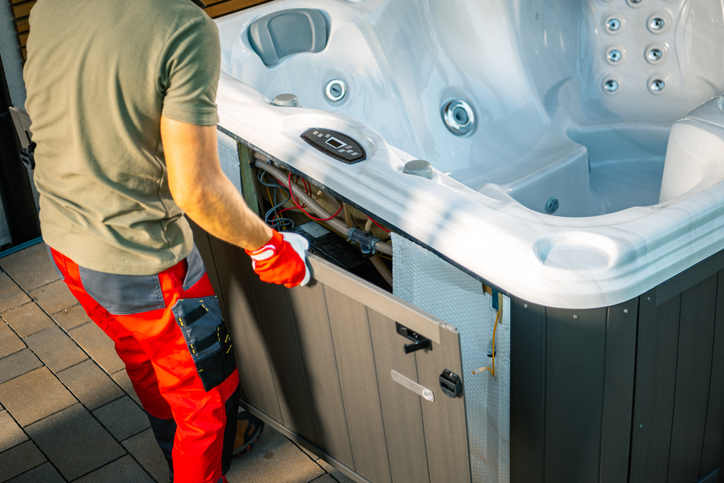
An appropriate plug-and-play model may be unplugged according to its manual. A hardwired spa needs a licensed electrician for disconnection. Any fixed or nonstandard utility connection should be handled by the correct qualified professional.
If you are unsure how to disconnect a hot tub for moving, do not guess. We do not recommend opening an electrical enclosure or attempting wiring work without the required training.
Step 2 — Drain the Hot Tub and Remove Residual Water
The shell must be fully drained before moving. Remove as much water as practical from accessible low points, following the model manual. A tub that still holds water is heavier and harder to control, so do not move it without draining it first.
For an above-ground spa, the QuickDrain Hand-Held Drain can drain and vacuum as the water level falls. For grit and debris cleanup, browse the hot tub vacuum collection.
For complete hot tub draining instructions, use the dedicated guide. Do not dismantle plumbing unless the manufacturer specifically requires it.
If the spa will be transported or stored in freezing temperatures, follow its model-specific winterization procedure to clear trapped water from pumps and plumbing, or hire a spa technician. See our guide to how to winterize a hot tub.
Step 3 — Remove Accessories and Protect the Hot Tub
Remove the cover, cover lifter, steps, handrails, headrests, filters, trays, and any other detachable parts as applicable. Photograph connections before disassembly, and keep screws, brackets, and fittings organized in labeled bags for easier reassembly.
Once the loose components are removed, clear away any grit with a quick wipe or vacuum so it cannot scratch the spa during handling. Protect the shell, cabinet panels, corners, acrylic surfaces, and equipment compartment with appropriate padding, but avoid placing adhesive tape directly on finished surfaces.
Transport the cover separately and keep it fully supported to prevent bending, crushing, or dragging. Never use the cover as a lifting or support point for the spa.
If the hot tub needs a more thorough clean before or after the move, see our guide on how to clean your hot tub.
Step 4 — Raise the Spa and Position the Dolly or Spa Sled
Follow the spa manufacturer’s lifting points and the moving-equipment instructions. Under one person’s direction, keep the spa supported by purpose-rated equipment, center and secure the load, and stop immediately if it becomes unstable.
Keep hands, feet, and unsupported body parts out from under the spa. Do not assume every model should be tilted onto the same side. Equipment compartments and structural requirements vary.
Step 5 — Move the Hot Tub Along the Planned Route
Move slowly under one person’s direction. Spotters should watch the balance, wheels, corners, clearances, and changes in the surface. This control is especially important across a yard or grass, where wheel resistance and soft spots can change suddenly.
Use plywood or another properly supported surface over suitable soft ground. The path must support the combined load without flexing, shifting, or sinking.
Do not drag the cabinet over concrete, gravel, pavers, or decking. If the route differs from the plan or the load becomes unstable, stop and reassess rather than improvising.
Step 6 — Load and Secure the Hot Tub for Transportation
Confirm the capacity of the ramp, liftgate, trailer, or truck before loading.
Control the spa during loading, pad all contact points, and secure it with transport-rated cargo tie-downs attached to rated vehicle or trailer anchor points, following each manufacturer’s instructions. Secure the cover and other accessories separately, then check that the spa cannot shift.
Do not use a spa-cover wind strap as a vehicle cargo restraint unless its manufacturer rates it for that purpose. Follow the trailer and cargo-restraint manufacturers’ loading and tie-down instructions; do not improvise.
Step 7 — Transport, Unload, and Place the Hot Tub
Drive smoothly and avoid abrupt stops or turns. On a longer trip, stop in a safe location and recheck the load and tie-downs as directed by the vehicle, trailer, and restraint manufacturers.
At the destination, reverse the process with the same planning and communication. Place the spa in its final orientation before removing the moving equipment. Confirm service-panel access and cover-lifter clearance first.
Moving a Hot Tub Through Difficult Areas
How to Move a Hot Tub Across Grass, Gravel, or Soft Ground
An appropriately supported plywood path can create a firmer rolling surface over suitable grass or soft ground. The plywood and moving equipment must support the full combined load without flexing, shifting, or sinking.
Do not drag the spa, and delay the move if the ground is saturated, unstable, or too soft for the planned equipment.
How to Move a Hot Tub Through a Gate or Tight Space
Measure the full clearance, including protrusions, turns, railings, and the permitted tub orientation. A gate or railing may need professional removal, but do not force the spa through a route that conflicts with the manual.
If the required orientation will not fit, choose another route or hire movers with suitable equipment. Do not force the spa through a route that is too narrow or substitute improvised rollers or unrated equipment.
Moving a Hot Tub on Stairs, Slopes, or an Elevated Deck
Stairs and slopes create more danger because gravity, limited footing, and restricted escape routes reduce control. An elevated deck may also have limits that are not visible from the surface.
We recommend a professional assessment instead of a makeshift stair-ramp method. A crane or purpose-rated lifting system may be needed when no safe ground-level route exists, and qualified professionals should assess and perform that lift.
What to Do After Moving the Hot Tub
Inspect the Spa Before Refilling
Visually inspect the shell, cabinet, equipment area, plumbing connections, pumps, heater mounts, and drain fittings.
Do not open electrical enclosures. A qualified technician should check suspected structural, plumbing, or electrical damage before the spa is filled or energized.
Reconnect, Refill, Reinstall the Accessories, and Test
A licensed electrician should complete hardwired reconnection. Fill the spa according to its manual before restoring power, then follow the instructions for how to fill a hot tub correctly.
After confirming the final position and clearances, reinstall the cover, lifter, steps, and other accessories. Follow the guide to install your hot tub cover lifter. If the current lifter does not suit the new placement, compare replacement cover lifters.
Test circulation, jets, controls, and heating according to the startup instructions. Check for leaks, unusual noises, error codes, and loose parts before normal use.
How Much Does It Cost to Move a Hot Tub?
There is no single reliable price for moving a hot tub. DIY expenses may include purpose-rated equipment and vehicle rental, cargo tie-downs, padding, plywood, permits, electrical work, and additional labor.
Professional quotes vary with distance, spa dimensions and dry weight, access obstacles, crane or specialized-equipment needs, storage, and reconnection. Compare written local quotes that define the full scope of work and applicable insurance coverage.
Common Hot Tub Moving Mistakes to Avoid
- Moving without enough capable help or without checking the manual and warranty.
- Guessing the dry weight or using unrated dollies, ramps, straps, or vehicles.
- Failing to measure the complete route or prepare the destination.
- Moving before the shell is fully drained and practical residual water is removed.
- Dragging the spa, skipping padding, or transporting the cover without support.
- Using an unapproved orientation or failing to stop the load from shifting.
- Restoring power before inspection and filling, or continuing when conditions become unsafe.
Frequently Asked Questions (FAQs)
Can You Move a Hot Tub on Its Side?
Some models may be transported on a permitted side, but this is not universally safe. The manufacturer manual or an experienced spa mover should identify the correct orientation and required support.
How Heavy Is an Empty Hot Tub?
Dry weight varies greatly by model and size. Use the model specification rather than an average when choosing equipment, helpers, and transportation.
How Many People Does It Take to Move a Hot Tub?
There is no universal number because the safe crew depends on verified dry weight, route, equipment, and professional guidance. A conventional hard-shell spa should never be moved alone.
How Long Does It Take to Move a Hot Tub?
A short same-yard move may take less time than a move that includes draining, disconnection, loading, transport, unloading, and reconnection. Weather, tight access, stairs, and other complications can add substantial time.